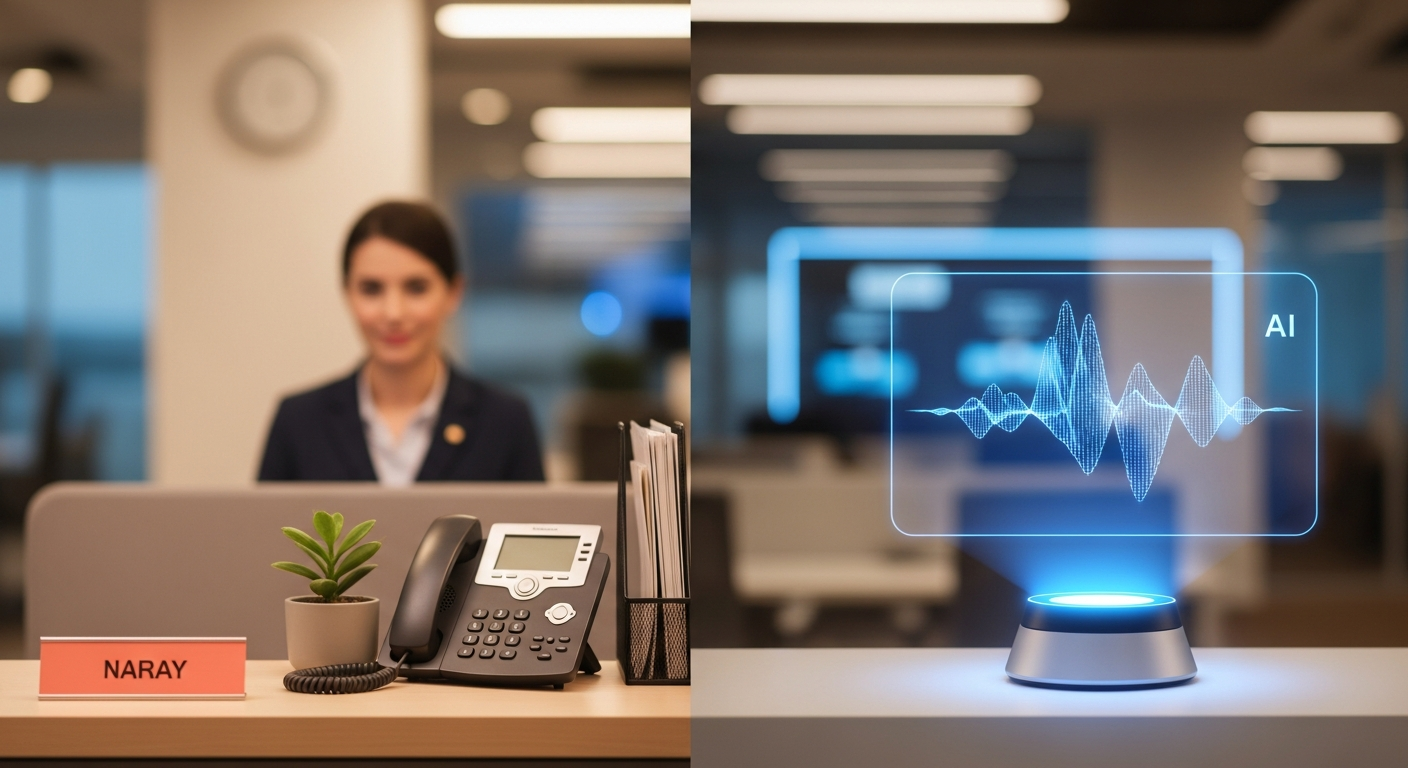
Do You Need a Live Receptionist, AI Receptionist, or Both?
Do You Need a Live Receptionist, AI Receptionist, or Both?
Every professional services firm needs someone or something answering the phone. The question is what combination of human and technology gives you the best coverage, the best client experience, and the best return on your investment.
The options have expanded significantly in recent years. You can hire a full-time in-house receptionist. You can outsource to a live answering service. You can deploy an AI receptionist. Or you can combine them. Each approach has trade-offs, and the right choice depends on your firm's size, call volume, budget, and client expectations.
The In-House Receptionist
The traditional approach. You hire someone to sit at the front desk, answer phones, greet visitors, and manage the lobby. They know your firm, your team, and your clients. They can handle unusual situations, read emotional cues, and provide the kind of warmth that builds relationships.
The downsides are well-known. A single receptionist can only handle one call at a time. They take lunch breaks, get sick, take vacations, and eventually leave for other opportunities. During busy periods, calls stack up and go to voicemail. After hours, the phone goes unanswered.
The cost is significant. Salary, benefits, workspace, equipment, and training for a full-time receptionist typically runs $35,000 to $55,000 per year depending on your market.
For small firms with modest call volume, a full-time receptionist might be more capacity than you need. For large firms with heavy call volume, a single receptionist is not enough.
The Live Answering Service
Live answering services employ teams of receptionists who answer calls on behalf of multiple businesses. They follow scripts you provide, collect caller information, and either transfer calls or take messages.
The advantage is flexibility. You pay per call or per minute, so you only pay for what you use. Most services offer 24/7 coverage, so your phones are always answered. They can scale up during busy periods without you hiring additional staff.
The downsides are consistency and depth. The people answering your phones are also answering phones for other businesses. They may not know your firm well enough to handle complex questions. Caller experience can vary depending on which operator picks up. And per-minute pricing can add up quickly during high-volume periods.
Typical costs range from $0.75 to $2.00 per minute or $1 to $5 per call, depending on the service and complexity of your scripts.
The AI Receptionist
AI receptionists use natural language processing to hold conversations with callers. They can greet callers, ask qualifying questions, collect information, check calendars and schedule appointments, route calls to the right person, and provide basic information about your firm.
The advantages are compelling. AI receptionists handle unlimited simultaneous calls. They work 24/7/365 without breaks, sick days, or turnover. They follow your scripts perfectly every time. And they cost a fraction of human alternatives, typically $100 to $500 per month regardless of call volume.
The downsides are real but narrowing. AI cannot match a skilled human receptionist's ability to build rapport, handle emotionally charged callers, or navigate truly unusual situations. Some callers, particularly older demographics, may be uncomfortable speaking with an AI. And while the technology is good, it is not perfect. Complex accents, background noise, and unusual requests can trip it up.
For a deeper look at AI receptionist capabilities, read our article on how AI receptionists help small firms capture more leads.
The Hybrid Approach
This is where it gets interesting. Many firms are finding that the best solution is not choosing one option but combining them.
Model 1: AI First, Human Backup
The AI receptionist answers every call and handles routine tasks like screening, scheduling, and information collection. When a caller has a complex need or specifically requests a person, the AI transfers to a human, either in-house or through a live answering service.
This model maximizes efficiency. The AI handles 60-70% of calls without human involvement, reducing the workload on your human receptionist and allowing them to focus on calls that actually need a personal touch.
Model 2: Human First, AI Overflow
Your in-house receptionist handles calls during business hours. When they are on another call, at lunch, or unavailable, the AI picks up overflow calls. After hours, the AI handles everything.
This model preserves the human touch as the primary experience while ensuring no call goes unanswered. It is particularly effective for firms where clients expect to speak with a person but call volume occasionally exceeds what one receptionist can handle.
Model 3: AI Screening, Live Service Escalation
The AI answers all calls and performs initial screening. Prospective clients are transferred to a live answering service for a warm, personalized intake experience. Existing clients with routine questions are handled by the AI. Urgent matters are transferred directly to staff.
This model is cost-effective because the expensive live answering service minutes are only used for high-value interactions, while the affordable AI handles everything else.
Factors to Consider
Call Volume
If you receive fewer than 20 calls per day, a single receptionist (human or AI) can handle everything. Between 20 and 50 calls, you need backup coverage. Above 50 calls per day, you almost certainly need a combination approach.
Client Demographics
If your clients skew younger and tech-savvy, they are generally comfortable interacting with AI. If your client base is older or less tech-comfortable, you may want a human as the primary contact with AI as backup.
Complexity of Calls
If most incoming calls are straightforward (scheduling, basic questions, routing), AI handles them well. If calls frequently involve complex situations, emotional callers, or nuanced conversations, human involvement is more important.
Budget
An AI receptionist at $200/month is dramatically cheaper than a full-time employee at $3,500/month or a live service that could run $1,000+ during busy periods. If budget is tight, AI-first with selective human escalation gives you the most coverage for the lowest cost.
Hours of Coverage
If you need 24/7 coverage, AI is the most cost-effective option for nights and weekends. Supplement with human coverage during your busiest business hours.
Making the Decision
For most small to mid-size professional firms, a hybrid approach delivers the best results. The specific combination depends on your circumstances, but a common starting point is an AI receptionist handling after-hours calls and overflow, with a human receptionist or live service covering primary business hours.
As AI technology continues to improve, the balance will shift further toward AI handling more interactions. But for now, the firms getting the best results are the ones using both tools strategically. If after-hours coverage is your primary concern, our article on stopping after-hours calls from becoming lost business dives deeper into that specific challenge. And for more on call data and training, read our piece on how call recording and analytics improve intake.
For a broader look at phone system options, visit our guide on business phone systems for professional services.