How to Build a Breach Response Plan for a Small Firm
Every professional services firm needs a breach response plan. Not because it is a nice idea, but because when a breach happens (and statistically, it will), the worst possible time to start figuring out what to do is while it is happening.
The problem is that most breach response plan templates are written for enterprises with 500-person security teams and dedicated war rooms. That is not helpful for a 15-person accounting firm or a 30-person law practice. You need something right-sized.
Here is how to build a breach response plan that actually works for a small firm.
Why Most Small Firms Do Not Have One
Let us be honest about the reasons:
- "We are too small to be a target." (You are not. Small firms are easier targets.)
- "We will figure it out when it happens." (You will not. Decisions made under panic are usually wrong.)
- "We do not have the expertise to create one." (You do now.)
- "It is on our to-do list." (It has been there for three years.)
The reality is that a usable breach response plan can be created in a few hours. Not days or weeks. A few focused hours that could save your firm from devastating consequences.
The Structure
Your plan should have five sections. Keep it concise. If your breach response plan is longer than 10 pages, nobody will read it when they actually need it.
Section 1: Incident Classification
Not every security event is a breach. Your plan should define what counts:
**Level 1: Security Event.** Something suspicious happened but no compromise is confirmed. Examples: a phishing email was received (but not clicked), unusual login attempts that were blocked by MFA, a suspicious attachment quarantined by email filtering.
**Level 2: Security Incident.** A compromise occurred but the scope is limited and no client data was accessed. Examples: malware detected and contained on a single workstation, an employee's personal (non-work) credentials were found in a data dump.
**Level 3: Data Breach.** Client data or sensitive firm data was accessed, stolen, or exposed. Examples: ransomware encrypted file servers containing client data, an email account containing client financial information was compromised, client data appeared on the dark web.
Each level triggers different response actions. Level 1 might just require investigation and monitoring. Level 3 triggers the full plan.
Section 2: Response Team and Roles
For a small firm, you do not need a 20-person response team. You need clear ownership of a few key roles:
**Incident Commander.** Usually a managing partner or firm administrator. This person makes decisions, approves communications, and coordinates the response. They do not need to be technical. They need to be calm, decisive, and available.
**Technical Lead.** Your IT person, managed service provider, or the most technically capable person at the firm. They handle containment, investigation, and remediation. If you outsource IT, include your provider's emergency contact information.
**Communications Lead.** Handles all internal and external communication. Client notifications, staff updates, media inquiries (if applicable), regulatory notifications. This person should have pre-drafted communication templates.
**Legal Advisor.** For law firms, this may be internal. For other firms, identify external counsel experienced in data breach response before you need them. They advise on notification obligations, liability, and regulatory compliance.
Include the name, phone number, personal email (in case corporate email is compromised), and backup contact for each role.
Section 3: Response Procedures
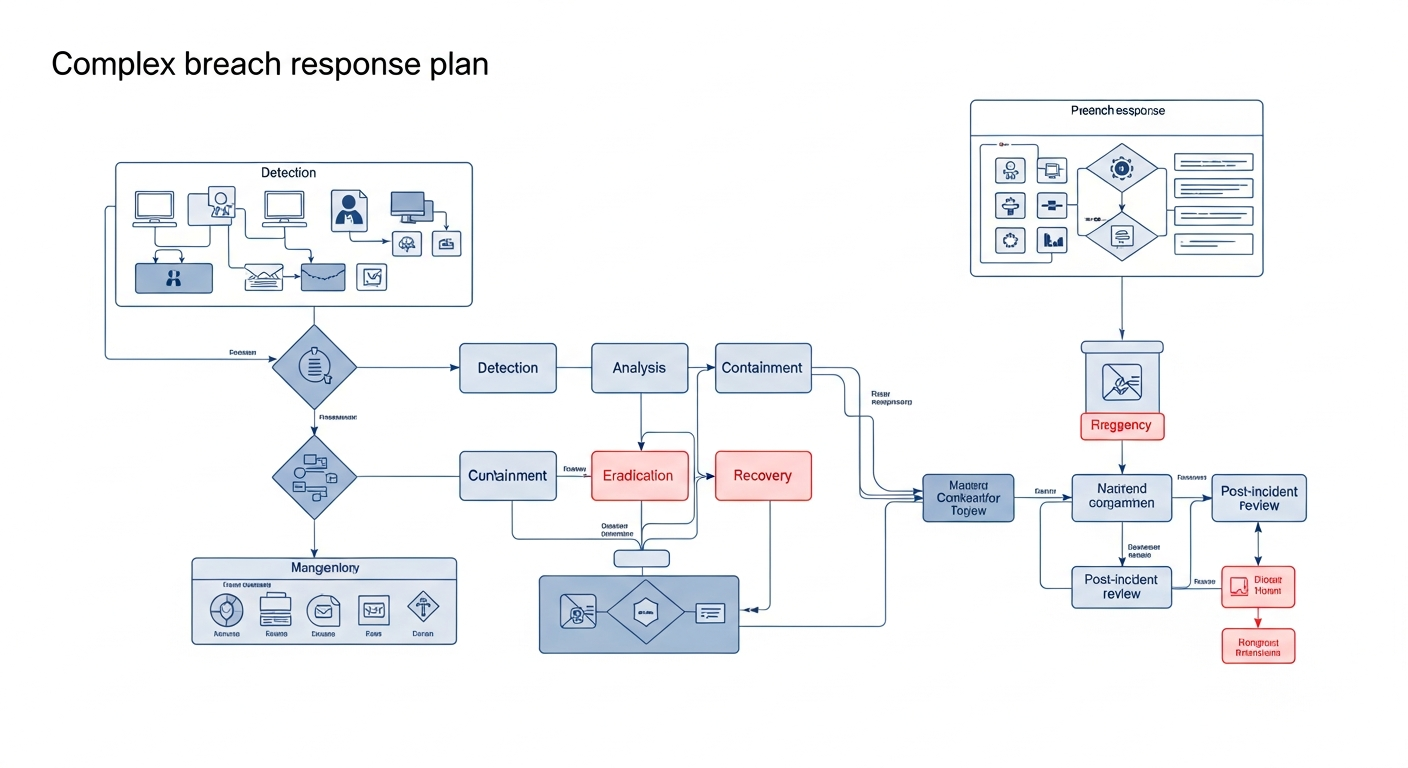
This is the heart of the plan. Break it into phases.
**Phase 1: Detect and Confirm (0-2 hours)**
- Verify the incident is real (not a false alarm)
- Classify the severity level
- Activate the response team
- Begin documenting everything with timestamps
**Phase 2: Contain (2-8 hours)**
- Isolate affected systems from the network
- Disable compromised accounts
- Preserve evidence (do not delete or reformat)
- Assess whether the attack is still active
Read our detailed guide on what to do in the first 24 hours after a breach for a complete hour-by-hour walkthrough.
**Phase 3: Investigate (8-48 hours)**
- Determine the attack vector (how they got in)
- Identify what data was affected
- Map the extent of the compromise
- Engage forensic investigators if needed
**Phase 4: Remediate (24-72 hours)**
- Close the attack vector
- Reset all potentially compromised credentials
- Rebuild or clean affected systems
- Restore from clean backups
- Enhance monitoring for the post-incident period
**Phase 5: Recover and Communicate (48 hours onward)**
- Notify affected clients per legal requirements
- Report to regulatory bodies as required
- File cyber insurance claim
- Conduct root cause analysis
- Update security controls based on lessons learned
Section 4: Contact Directory
Maintain a current list of everyone you might need during an incident. Print a physical copy and store it separately from your digital systems (because those might be unavailable during a breach).
- Response team members (personal cell phones and emails)
- IT service provider emergency number
- Cyber insurance carrier claims number and policy number
- Legal counsel specializing in data breach response
- Forensic investigation firm (have a relationship before you need them)
- FBI field office and IC3 contact information
- State attorney general's office (for breach notifications)
- CISA reporting channels
Section 5: Communication Templates
Pre-draft communication templates that can be customized during an incident:
**Internal staff notification.** "We have identified a security incident affecting [describe]. Here is what we know, what we are doing, and what you need to do."
**Client notification.** Draft letters that comply with your state's breach notification requirements. Include what happened, what data was affected, what you are doing about it, and what clients should do.
**Media statement.** Keep it brief. "We are aware of a security incident and are working with cybersecurity experts to investigate and resolve it. The security of our clients' data is our top priority."
Making It Practical
A plan that sits in a drawer is not a plan. Here is how to make yours actionable.
**Keep it accessible.** Store the plan in multiple locations: digitally (encrypted cloud storage), physically (printed copy in a secured location), and with your IT provider. During a breach, your primary systems may be unavailable.
**Review quarterly.** Contact information changes. Staff changes. Technology changes. Review and update the plan every quarter. It takes 15 minutes.
**Practice annually.** Run a tabletop exercise at least once a year. Walk through a hypothetical scenario as a team. "It is Tuesday morning and ransomware has encrypted our file server. What do we do?" This reveals gaps in the plan and builds muscle memory.
**Test your backups.** Your plan probably assumes you can restore from backups. Verify that assumption. Perform test restores quarterly.
Common Mistakes in Breach Response Plans
**Being too generic.** "Contact IT" is not a procedure. Include specific names, numbers, and steps.
**Forgetting about communication.** Many plans focus entirely on technical response and forget that clients need to be notified, insurance carriers need to be contacted, and staff need to be informed.
**Not accounting for system unavailability.** If your email is compromised, how will you communicate? If your file server is encrypted, where is the plan? Build in redundancy.
**Ignoring regulatory requirements.** Different states have different notification timelines and requirements. Your plan needs to account for the specific laws that apply to your firm and clients. Understand the common compliance gaps so your plan addresses them.
**Never testing it.** An untested plan is just a document. Testing reveals whether it actually works.
Getting Started Today
If you do not have a breach response plan, start with the basics:
1. Assign the four key roles (Incident Commander, Technical Lead, Communications Lead, Legal Advisor) 2. Create the contact directory with personal phone numbers 3. Write out the five-phase response procedure 4. Draft basic communication templates 5. Schedule your first tabletop exercise for next month
This does not need to be perfect on day one. It needs to exist. You can refine it over time.
The firms that survive breaches are not the ones with the biggest security budgets. They are the ones that had a plan, practiced it, and executed it when it mattered.
For broader guidance on building a resilient security program, explore our cybersecurity guide for professional services.