AI for Client Intake: Where It Helps and Where It Fails
Client intake is one of those processes that every firm knows could be better but few firms prioritize. It sits in an awkward spot: important enough that doing it poorly costs you clients, but mundane enough that nobody wants to spend time optimizing it.
That is exactly why AI is such a good fit for intake. AI excels at repetitive, process-driven work that follows predictable patterns. And client intake, at its core, is exactly that. Someone expresses interest, you collect their information, qualify them, and start the engagement process.
But AI intake is not perfect, and understanding where it helps versus where it fails will save you from expensive mistakes.
Where AI Intake Works Beautifully
**Speed of response.** This is the single biggest advantage. When a prospective client fills out a form on your website at 9pm on a Tuesday, AI can respond immediately. Acknowledge receipt, ask qualifying questions, even schedule a consultation, all within minutes. Studies consistently show that the first firm to respond meaningfully to an inquiry wins the client 50-70% of the time. Speed matters more than almost anything else in intake.
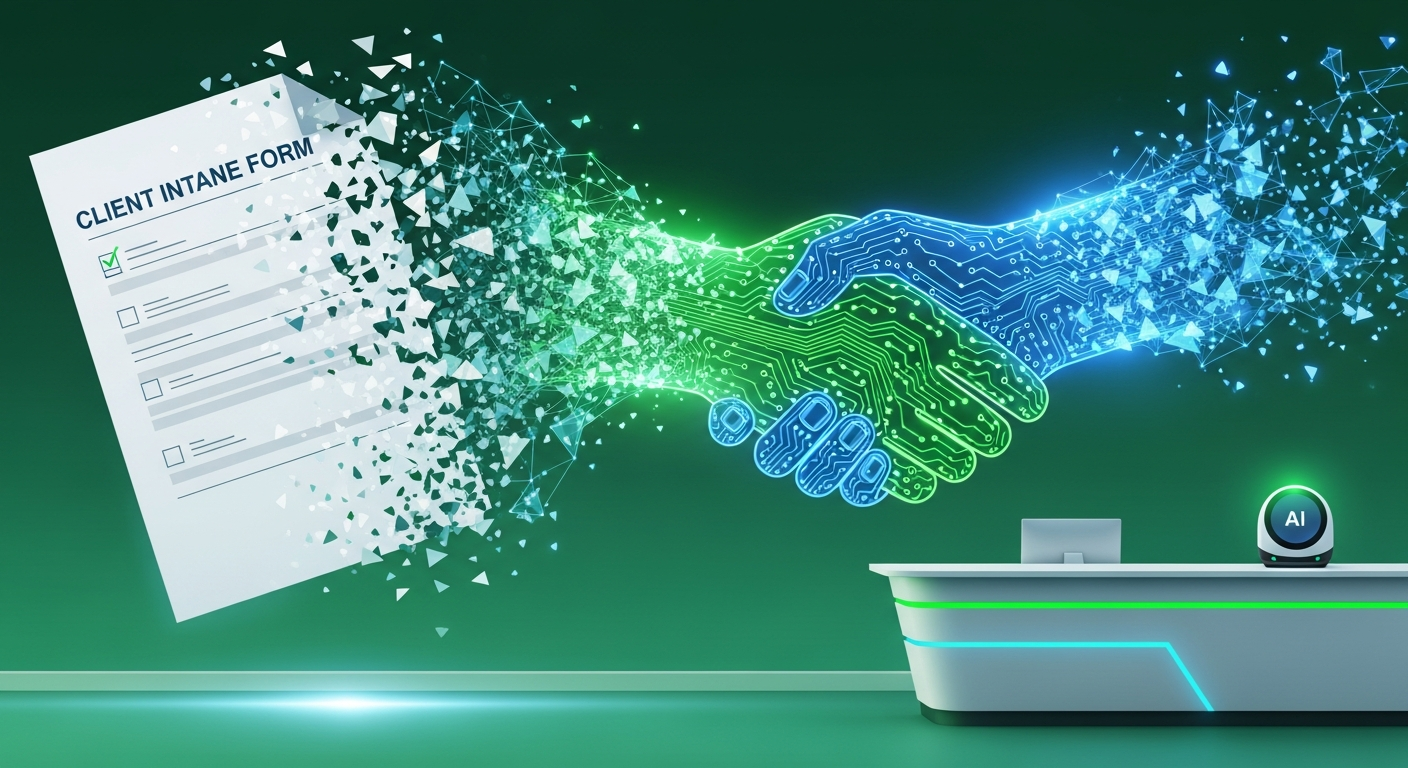
**Data collection and organization.** AI intake systems can ask the right questions based on the prospect's initial responses, gather necessary documents, and populate your systems automatically. No one on your team needs to manually enter the prospect's name, email, phone number, business type, and service needs into your CRM. The AI handles it.
**Qualification and routing.** Not every inquiry is a good fit. AI can qualify prospects based on criteria you define: business size, service needs, geography, budget range. Good fits get fast-tracked to a partner or senior team member. Poor fits get a polite response directing them elsewhere. This saves your most expensive people from spending time on prospects who will never become clients.
**24/7 availability.** Your human team works business hours (and probably too many hours beyond that). AI works around the clock. Weekend inquiries, holiday inquiries, middle-of-the-night inquiries from a stressed business owner who just got an IRS notice: AI handles them all.
**Consistency.** Human intake varies based on who answers the phone, what kind of day they are having, and how busy the office is. AI delivers the same professional experience every time. Every prospect gets the same quality of interaction regardless of when they reach out.
Where AI Intake Falls Short
**Complex situations that need empathy.** A business owner calling because they just got sued needs more than a form and automated response. A family reaching out about estate planning after a death needs sensitivity that AI cannot provide. For these high-emotion situations, AI should capture basic information and escalate to a human quickly.
**Nuanced qualification.** AI can qualify based on explicit criteria (industry, size, service type) but struggles with implicit signals. An experienced intake coordinator can hear uncertainty in someone's voice and know they need reassurance. They can detect that a "simple tax question" is actually a complex situation that needs a partner's attention. AI misses these nuances.
**Relationship building.** For professional services firms, the intake process is the beginning of a relationship. Clients hire firms they trust, and trust starts with human connection. AI can handle the mechanics of intake, but it cannot replace the warmth of a real conversation with someone who understands your situation. The firms that over-automate intake and remove the human element entirely often find their conversion rates dropping.
**Edge cases and exceptions.** AI works well for the 80% of intake inquiries that follow standard patterns. But every firm gets inquiries that do not fit the mold. The prospect who needs a combination of services. The referral from an existing client who expects special treatment. The complex situation that does not map to any of your standard service offerings. AI handles these poorly without significant customization.
The Right Architecture for AI Intake
The best approach is a hybrid model. AI handles the initial response, data collection, and routine qualification. Humans handle the relationship building, complex qualification, and engagement decisions.
Here is what that looks like in practice:
**Stage 1: AI captures and responds.** Prospect submits an inquiry (web form, phone call, email). AI acknowledges receipt within minutes, asks qualifying questions, and collects basic information. If it is after hours, AI lets the prospect know when a team member will follow up.
**Stage 2: AI qualifies and routes.** Based on the prospect's responses, AI determines the appropriate team member and priority level. High-value prospects get immediate notification to a partner. Standard prospects get queued for the next available team member. Poor fits get a professional response with alternative suggestions.
**Stage 3: Human connects.** A real person reaches out to the qualified prospect. They have all the information AI collected, so the conversation starts at a higher level. Instead of "tell me about your business," it is "I see you are a 15-person law firm looking for tax planning help. Let me tell you how we have helped firms like yours."
**Stage 4: AI handles the paperwork.** After the human conversation, AI generates the engagement letter, sets up the client in your systems, schedules the kickoff meeting, and sends welcome materials. The human is already moving on to the next prospect.
Measuring AI Intake Performance
If you implement AI intake, measure these metrics:
Response time to initial inquiry. This should drop to under 5 minutes. If it does not, something is wrong with your setup.
Prospect-to-consultation conversion rate. This should improve because you are responding faster and qualifying better. If it drops, your AI might be off-putting prospects.
Time spent per prospect by human team members. This should decrease significantly for routine prospects. If it does not, the AI is not actually reducing their workload.
Client satisfaction during onboarding. Survey new clients about their intake experience. If scores drop after implementing AI, you have over-automated somewhere.
Integration Matters
AI intake tools work best when connected to your other systems. For a deeper look at how automation fits together, see AI workflow automation for small firms. The intake data should flow directly into your CRM, practice management system, and billing platform. Manual re-entry at any point defeats the purpose.
If you are interested in what a firm-wide AI assistant can do beyond intake, read our breakdown of AI assistants for small firms.
Also consider how intake connects to your marketing. If your website generates the inquiry, can the AI tool track which page or campaign drove the lead? This data helps you optimize marketing spend, which is increasingly important as client acquisition costs rise.
The firms getting the most value from AI intake treat it as one component of a broader automation strategy, not an isolated tool. When intake flows into onboarding, which flows into engagement management, which flows into client communication, the cumulative time savings are substantial.
For more on building a comprehensive AI strategy for your firm, see our guide to AI for Accounting Firms.